Fish Tale (Postscript – Photography Insights)
It was an amazing summer, as we were blessed with six or seven ospreys on our part of the lake. Although ospreys are not known to remain together as a family or social flock, except as mating pairs, you could often see several drawn to the same spot when the fishing was good.
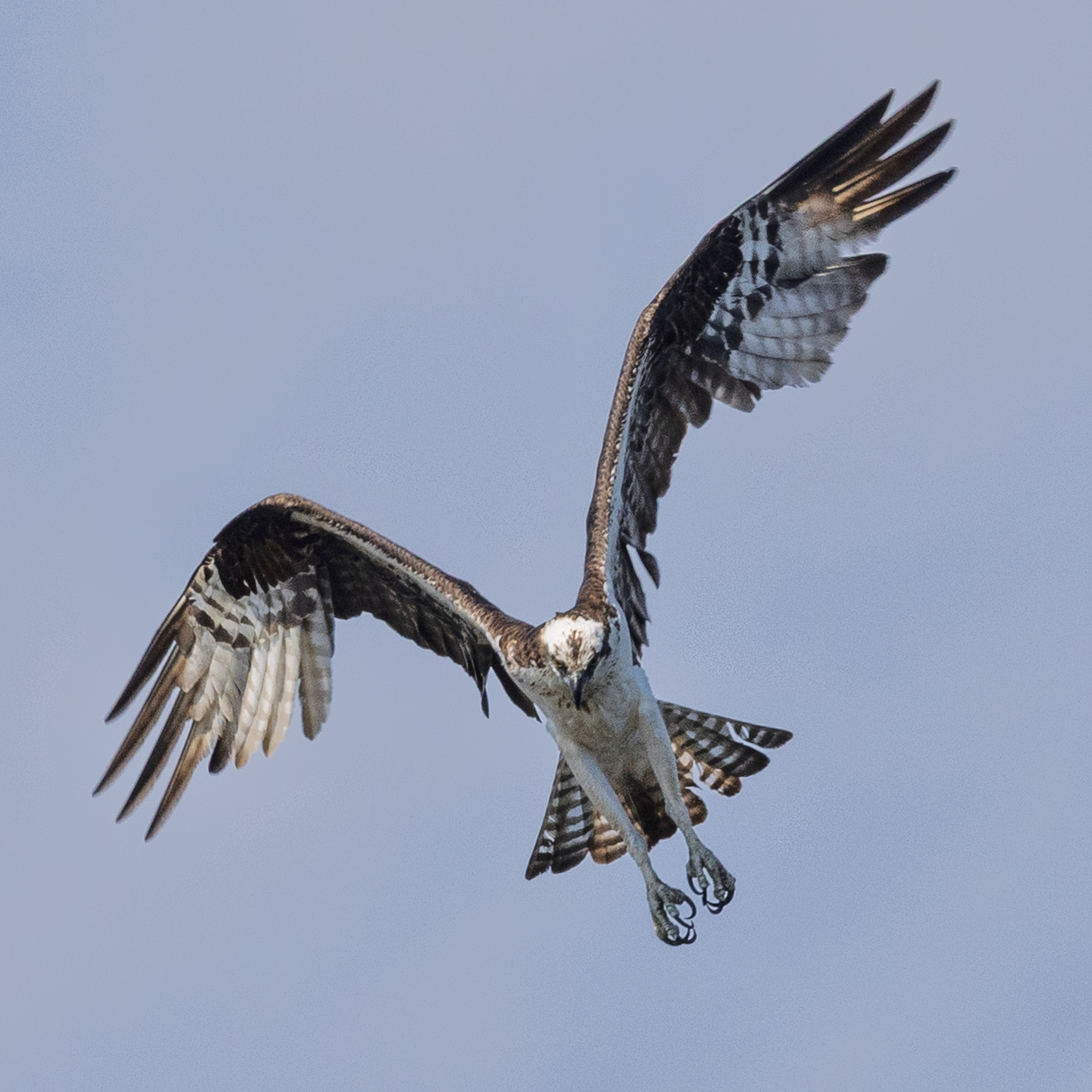
It took patience and several weeks to capture the perfect shots for this series. Most were taken from shore, but on several occasions I also enjoyed shooting from the kayak. Mornings offered the best opportunities: the ospreys were fishing and most active, and the sun was in the right position to highlight the feathers, talons, and other features of these magnificent birds of prey.
Canon’s technology is amazing for this type of handheld photography, thanks to the image stabilization in both the camera and the lens. Still, choosing a fast enough shutter speed was a mental challenge for me, especially for the “dive” images, in which an osprey can reach speeds of 80 mph. I started out shooting the ospreys in my usual manual (“M”) mode, thinking that 1/600 or 1/800 of a second would be fast enough. After downloading the early images to my computer, however, I found that many were blurry. Because I let the ISO float, I get nervous about increasing the shutter speed: doing so also raises the ISO, which can cause excessive noise, the grainy look that often appears in low-light situations. It was not until I increased the shutter speed to around 1/2000 of a second that a crisp image of a diving osprey finally appeared on the screen. Fortunately, the ISO did not climb too high, and I was able to achieve the clarity I was hoping for.
Finally, the Canon RF 100–500mm is the longest telephoto lens I have ever used, and this summer marked my first venture into the world of super-telephoto photography. It made capturing our ospreys a lot of fun, but even so, I had to crop some images during processing to make the osprey fill the frame. If I were to pursue bird and waterfowl photography more seriously, I think it would be worthwhile to invest in a Canon RF 1.4x Extender for greater optical reach.
I have a couple of “bucket-list” waterfowl species that I’ll be watching for during next spring’s migration season, and I hope to have more to share with you in the future. Thanks for following along with this 10-part osprey fishing adventure. I hope you had as much fun as I did seeing these magnificent birds up close.
≡Canon R5/RF100–500 · 500mm · f/10 · 1/1600 sec · ISO 400